Category Archives: History

A Vision of Biddestone Through Time

Here is a delightful excerpt from A Home Tour through the Manufacturing Districts of England in the Summer of 1835, by George Head (New York: Harper and Brothers, 1836). I found it on that most excellent of websites, “A Vision of Britain Through Time“, which I commend to all local and family historians in need of historical and geographical context for British place names since 1801.

BIDDESTONE LIGHTHOUSE

As I was walking from Woodside towards Biddestone lighthouse, the day being hot, I heard the clattering of hoofs behind me, and was accosted by a little boy, with the offer of a pony. I at first sight thought the whole troop were donkeys; but, on a second glance, I did certainly perceive that one of the quadrupeds really was a pony. The boy had just emerged, with his long-eared squadron, from the village of Biddestone, on his way to Woodside, in order to pick up customers for the day.

The colour of the steed in question was a light sandy dun, a black streak extending the whole length from the withers to the tail; which mark of distinction not only assimilated him to his companions, but, from long habits of intimacy, his manners had become so near akin to theirs, that in reality he was, morally speaking, just as much a jackass as a horse. Such as he was, I immediately engaged his services, upon paying a shilling down, with a promise of more, according to time, on delivery. I was also furnished with a stick into the bargain, which latter I soon found was doomed to more wear and tear in my service than the pony, which was of a nature at all events not to be ridden away with. In a few minutes he was tied up to a rack of hay in a stable belonging to the lighthouse.

Biddestone Hill, about three miles from Woodside, commands an extensive view of the country inland, while the forest of signal poles, with which the lighthouse is surrounded, give it, at a distance, an extraordinary appearance—that of a dock or harbour on the top of a hill. Hence the merchant vessels bound to Liverpool are signalled and telegraphed in the offing, the poles alluded to bearing the private signals of different individuals. And what must be remarked as rather singular is, that, notwithstanding the arduous duty which necessarily falls on the station, the whole is performed, almost exclusively, by young women, daughters of the veteran in charge. The old man, who is thus ably supported in the winter of life, is fourscore years old, and has held the office upward of forty years. Although boys are employed to run backward and forward, out of doors, with colours to the poles, and haul them up; and one of the three young women is married, and occasionally assisted by her husband; yet it is she who, being perfect in the whole code of signals, performs the responsible part of the duty. This couple were both at work together at the time I arrived, the young woman keeping the lookout, and calling the numbers, while the man, merely at her bidding, pulled the ropes. She not only kept him employed, but managed meanwhile to iron a shirt into the bargain.

The business of the youngest sister is to attend the light, consisting of eleven Argand lamps, with plated reflectors. Every four hours during the night the lamps are trimmed; these, the stove, copper, oil jars, and paved floor, are preserved in a state of cleanliness not to be exceeded; while no doubt, many a mariner, on a wintry and stormy night, both knows and feels that his life and safety are thus well confided to the never-failing care of — woman.

The old man is William Urmson, who died later that very year. The three women were the surviving daughters of his second wife:  Ann (who was to succeed William as keeper), Catherine (the youngest), and Jane, wife of Thomas Nichols, the Telegraph Keeper.

It’s interesting to note that the single massive reflector of 1771 has been replaced by 11 smaller reflectors. Both William Hutchinson himself (in his Treatise of Practical Seamanship), and later, Robert Stevenson (the Scottish lighthouse engineer who visited in 1801), recommended multiple smaller reflectors instead of a single big one.
Dutch visitors

Recently, a Dutch gentleman, whom we shall call Jan VIII, visited Leasowe and Bidston Lighthouses. I hope Jan VIII and his gracious wife will forgive me for greeting them with a paintbrush in hand.

Jan VIII was retracing the footsteps of his ancestor, Jan van Heukelom (1784-1847). The elder Jan, whom we shall call Jan IV, visited England in 1805 and kept a detailed journal of his travels. These were interesting times. England was at war with France, alarm beacons were erected on Bidston Hill in April, and the Battle of Trafalgar was fought on 21st October.

Here is an extract from Jan IV’s journal entry for Monday 16 September, 1805, when he paid a visit to Bidston Lighthouse. My thanks go to Jan VIII for sharing his annotated transcription, and to Woutera Willemsen for translating this passage from the Dutch.

“I then crossed the Mersey in a boat with Rogers and walked to the lighthouse with him. It is but a kind of tower, with a room containing the light for the ships to navigate by when sailing into the channel. The light is a cotton lamp wick supplied by oil placed in front of an enormous reflector. This reflector is, I noticed, in the shape of a parabola and the lamp is in its focus. The largest circle must be approximately 18 feet wide and the reflector is made up of trapezia of mirror glass. The front of the room in which the lamp is located is entirely made of glass, which means the light can be seen freely. Closer to sea there is another smaller and lower beacon. The helmsmen must keep these two lights in a straight line in a certain position in the channel. These circumstances, which the caretaker informed me of and his statement that the light was by far not as visible from the side as from the front, strengthened my thoughts concerning the parabolic nature of the reflector. This lighthouse can be seen clearly from Liverpool. The pilots used this circumstance by placing a number of signal poles close to the lighthouse. As soon as a ship arrives from sea and comes within sight of this beacon, it will hoist its private flag from which the caretaker will recognize the owner. The caretaker will then go and hoist the owner’s flag on the designated pole while a general sign will show what kind of ship it is. This is how the Liverpool merchants (want to) know what is happening at sea close by. When we arrived back from the lighthouse, we just had time to dine after our crossing, which seemed to last a long time to me. Afterwards, I dressed and went to the theatre with Mr Tait and company.”

Jan IV used the English terms for “lighthouse” and “signal poles”, and the French “reverbère” for “reflector”.

What’s in a name?

As I mentioned back in “The Case of the Missing Letterbox“, we live on an unnamed road. It’s a narrow lane that runs up the hill from Boundary Road to the Lighthouse and Observatory on Bidston Hill.

But we can change that! As long as all the residents and owners agree on the new name, and we pay for the road signs, we can give our road a name. So, what should we call it?

We could name the road after one of the historic buildings to which it leads.

There’s been a lighthouse on the site since the 1771, when the first Bidston Lighthouse was built, further from the sea than any other lighthouse in Britain. This was after the Lower Sea Light at Mockbeggar Wharf had been destroyed by storms. The Upper Sea Light (the present Leasowe Lighthouse) became the Lower  Sea Light, and Bidston Lighthouse became the Upper Sea Light. It featured a massive parabolic reflector, 12 feet in diameter, developed on-site by William Hutchinson, which enabled the light to be seen at a distance of 21 nautical miles. The present Bidston Lighthouse was built by Mersey Docks and Harbour Board in 1873, after the original lighthouse was damaged by fire and demolished. Lighthouse Lane might be a good name for our road.

The Observatory was built in 1866, when the Liverpool Observatory relocated to Bidston Hill from what is now Waterloo Dock. It’s had many uses over the years, including chronometer calibration, tide prediction, meterological observations, signalling the firing of the One O’Clock Gun at Morpeth Dock, and offices for oceanographic research. The Proudman Oceanographic Laboratory was based here until 2004, when it relocated to the University of Liverpool. But it would be confusing to name the road after the Observatory, because there’s already an Observatory Road nearby.

Braehead Cottage used to sell teas. It was located outside the boundary wall that surrounds the Observatory and Lighthouse, near to the old coach house. It fell into disrepair after the war, and was demolished.

The Bidston Signals were once a prominent feature along the skyline of Bidston Hill. More than 100 flagpoles along the ridge of Bidston Hill signalled the approach of ships into Liverpool, allowing the merchants time to ready their crews for unloading. The signals service was augmented by a semaphore based telegraph system that connected Anglesey to Liverpool. The original Signals Station predated the first lighthouse. In 1873, the signals function was incorporated into the new lighthouse. Signals Road? Semaphore Lane? Too obscure, perhaps?

Or we could name the road after a historical person.

Richard Wilding was the first lighthouse keeper of Bidston Lighthouse, having served previously at Leasowe. When he died in 1797, his wife, Elizabeth took over as keeper, and served until 1800. Elizabeth Wilding was Liverpool’s first female lighthouse keeper. She got the job on the strict condition that “she shall continue to behave properly … and shall not attempt to employ or use the said Building called the Bidston Lighthouse or any of its Appendages as a Publick House”. Wilding Way has a certain ring to it.

Dr. Arthur Thomas Doodson (31 Mar 1890 – 10 Jan 1968) was a British oceanographer. He was Associate Director of the Liverpool Observatory and Tidal Institute when it formed in 1929. He is perhaps best known for the Doodson-Légé Tide Predicting Machine, the mechanical computer that was used to predict the tides for the D-Day landings. He lived and worked for a time at Bidston Observatory, and is buried in Flaybrick Cemetery. Mary Connell remembers him fondly. At Christmas he gave presents to the two Connell girls who lived in the Lighthouse Cottages, saying “here’s two-and-six for you and half-a-crown for you”. Mary was convinced that she was somehow missing out.  Doodson Drive or Doodson Lane might be good names for our road.

Joseph Proudman (30 Dec 1888 – 26 Jun 1975), CBE, FRS, was Honorary Director of the University of Liverpool Tidal Institute. The Proudman Oceanographic Laboratory and the Joseph Proudman Building were named after him. At the moment, there is some controversy about the future of the Joseph Proudman Building. A vocal few want it turned into a drumming school and Grade-II listed. We think it is an eyesore and should be demolished.

What do you think we should call our road?

Make your suggestion by commenting on this post.

Beacons on Bidston Hill

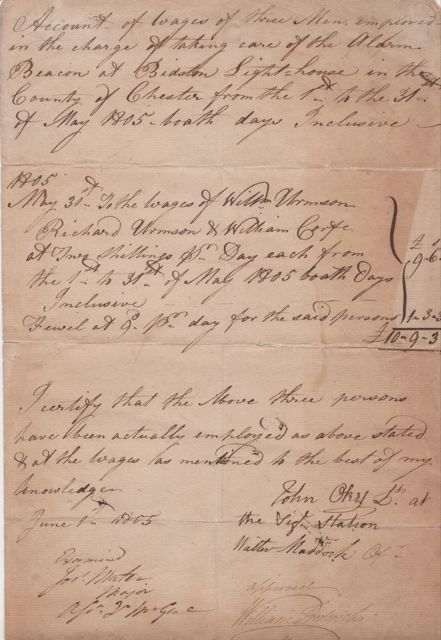
I recently acquired an old wages bill from 1805, which begins:

“Account of wages of three Men employed in the charge of taking care of the Alarm Beacon at Bidston Lighthouse in the County of Chester from the 1st to the 31st of May 1805, boath days Inclusive.”

The three men were William Urmson, Richard Urmson & William Corfe. They were paid 2 shillings per day each, and shared a fuel allowance of 9 pence per day. The bill was signed by John Oky Lt. at the Signal Station, and approved by William Frederick Lt. Gen.

I assumed at first that this was just the normal wages of the lighthouse keepers on Bidston Hill. But why did the bill talk about the Alarm Beacon? The lamp in Bidston Lighthouse might well be called a beacon, but its purpose, when lined up with Leasowe Lighthouse, was to light a safe passage through the channels of Liverpool Bay, not to warn off approaching shipping. And why were the men being paid through the army? Was this another kind of beacon altogether?

I already knew that William Urmson was the keeper of Bidston Lighthouse from 1797 until 1835. Richard Urmson was probably William’s son by his first wife Mary, Richard Wilding Urmson (1789-1817). The Corfe family have long been associated with farming on Bidston Hill. It turns out that William Frederick, who then had the rank of Lieutenant General in the Army, was none other than the great-grandson of King George II, soon to inherit the duchies of Gloucester and Edinburgh, and later to be known as “Silly Billy”.

In May 1805, Britain was at war with Napoleon, George III was on the throne, and Nelson was an Admiral in the Royal Navy. The French fleet had just broken the British blockade at Toulon in April, and were at large in the Atlantic. The Battle of Trafalgar (21 Oct 1805) was yet to be fought. There were real fears of a French invasion, and preparations had been made throughout the land, including an extensive network of alarm beacons.

This wasn’t the first time that beacons had been erected on Bidston Hill. In 1588, the year of the Spanish Armada, beacons were readied all along the coast of Britain, including one on the summit of Bidston Hill, and another at the top of Everton Ridge, overlooking the then small but important port of Liverpool.

Beacons have often been lit across Britain to celebrate historical events, including Queen Victoria’s Diamond Jubilee (1897), the 400th anniversary of the Spanish Armada (1988), the Millennium, the Queen’s Golden Jubilee (2002), and the 200th anniversary of the Battle of Trafalgar (2005).

As I write this, preparations are being made for the Queen’s Diamond Jubilee celebrations. Already, more than 2600 sites have signed up to light a beacon between 22:00 and 22:30 on the evening of 4th June 2012.

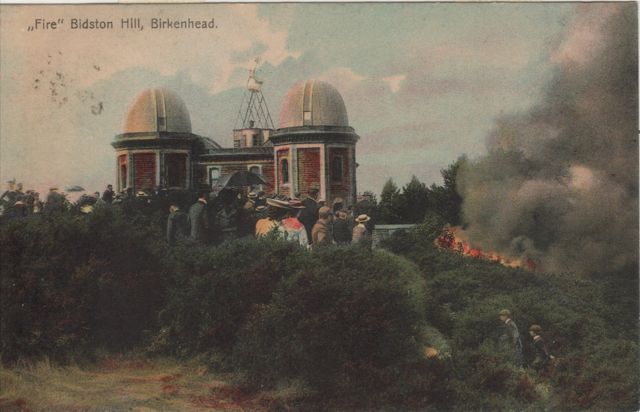
Will Bidston Hill join in? The possibility is still being discussed.  At first it sounds like a lot of fun, but what if the fire gets out of control? Fire has always been a problem on Bidston Hill. In the summer, the gorse dries out, catches fire easily and spreads rapidly when fanned by the stronger-than-average winds that Bidston Hill is exposed to. A fire, apparently extinguished, can smoulder in the peat deposits, travel underground and break out somewhere else. It is difficult, sometimes impossible, to bring fire engines close to the blaze, and the water pressure at the few hydrants on the hill is low. So as much as I’d like to see a beacon lit on Bidston Hill this jubilee, I’ll understand if caution prevails.

1805 wages bill

1805 wages bill for alarm beacon at Bidston Lighthouse

Fire by Bidston Observatory

Fire by Bidston Observatory, August Bank Holiday, 1904